Introduction:
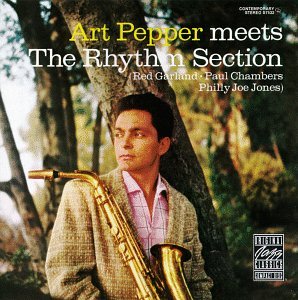
In the realm of jazz, certain albums transcend the ordinary, not just for their musical brilliance but for the stories and circumstances surrounding their creation. “Art Pepper Meets the Rhythm Section” is one such album. Released in 1957, this landmark recording brought together alto saxophonist Art Pepper and the formidable rhythm section of Miles Davis’ quintet—pianist Red Garland, bassist Paul Chambers, and drummer Philly Joe Jones. The result was nothing short of extraordinary, establishing the album as a cornerstone of both Pepper’s career and jazz history.
The Backstory: A Meeting of East and West
“Art Pepper Meets the Rhythm Section” was born under circumstances that could easily have led to a subpar recording session. According to Pepper, he was informed about the session on the very day it was scheduled, a situation exacerbated by the fact that he had not played the saxophone for an extended period. Depending on the source, this period ranged from two weeks (as noted in the album’s liner notes) to six months (as detailed in Pepper’s autobiography, “Straight Life”). Moreover, he was using a saxophone in poor repair and was struggling with a severe drug problem at the time. Despite these formidable obstacles, Pepper produced what many consider his finest work.
Help yourself to some live jazz, and help the artists and clubs fulfill their dreams. Sign up to Oh! Jazz to watch live and on-demand performances. 25% of your subscription goes back to the artists and 10% to the clubs.
Learn more about Oh! Jazz here.
Pepper had never met Garland, Chambers, or Jones before the session, though he had long admired their work with Miles Davis. The rhythm section, particularly Philly Joe Jones, had a reputation for being exacting and demanding—qualities that only added to Pepper’s anxiety. Yet, as the session progressed, the musicians found a remarkable synergy that belied their lack of rehearsal and preparation.
The Music: Cool Meets Hot in a Timeless Fusion
The album opens with Cole Porter’s “You’d Be So Nice to Come Home To,” where Pepper immediately sets the tone with a loose but precise interpretation of the melody. His playing, influenced by the cool, lyrical style of Lee Konitz and the fiery intensity of Charlie Parker, creates a unique blend that captivates from the first note. The rhythm section, with its East Coast hard-bop sensibilities, complements Pepper’s West Coast cool in a way that elevates the entire session.
“Red Pepper Blues,” a collaboration between Pepper and Garland, follows with a groove reminiscent of Milt Jackson’s “Bags’ Groove.” Here, Garland’s piano work is in perfect sync with Chambers’ bass and Jones’ drumming, providing a foundation that allows Pepper to explore the blues with a subtle yet powerful approach. The chemistry between the musicians is palpable, and their interplay on this track exemplifies the album’s seamless integration of different jazz styles.
One of the album’s standout tracks is “Imagination,” a ballad that Pepper approaches with an uncharacteristic delicacy. His alto saxophone glides over the changes with a lyrical, almost ethereal quality, showcasing his ability to convey deep emotion with remarkable restraint. Garland’s piano accompaniment is equally tender, and the result is a performance that has become one of the definitive interpretations of the song.
“Waltz Me Blues,” another Pepper composition, injects a burst of energy into the session. Co-written with Chambers, the track features a brisk waltz tempo that allows the quartet to demonstrate their technical prowess. Pepper’s saxophone lines are agile and inventive, while Chambers and Jones provide a rhythmically complex backdrop that pushes the music forward with relentless drive.
The album’s centerpiece, “Straight Life,” is a fast-paced, hard-edged tune that captures the urgency and intensity of Pepper’s playing. The title itself is a nod to the duality of Pepper’s life—his desire for a straight path juxtaposed against his struggles with addiction. The track is a whirlwind of improvisation, with Pepper pushing the limits of his instrument while the rhythm section matches his intensity note for note.
“Tin Tin Deo,” a Latin-tinged number composed by Chano Pozo and Gil Fuller, highlights Philly Joe Jones’ versatility as a drummer. His ability to seamlessly shift from Latin rhythms to swing provides the perfect foundation for Pepper’s exploration of the melody. Garland’s piano solo is a masterclass in harmonic sophistication, and Chambers’ bass playing is both rhythmic and melodic, adding depth to the arrangement.
“Star Eyes,” a jazz standard popularized by Charlie Parker, is given a fresh treatment by Pepper. The rhythm section once again proves their mettle, with Garland and Chambers in particular delivering standout performances.
The album closes with “Birks’ Works” and the bonus track “The Man I Love” (included in the 2002 remastered edition). “Birks’ Works,” a Dizzy Gillespie composition, finds Pepper in a more reflective mood, exploring the lower registers of his instrument with a depth of feeling that contrasts sharply with the intensity of the earlier tracks. “The Man I Love,” a Gershwin classic, is another example of Pepper’s ability to reinterpret standards in a way that feels both respectful and innovative.
Reception and Legacy: A Masterpiece Recognized
Upon its release, “Art Pepper Meets the Rhythm Section” was immediately recognized as a masterpiece. Michael G. Nastos of AllMusic called it “a classic east meets west, cool plus hot but never lukewarm combination that provides many bright moments for the quartet during this exceptional date from that great year in music, 1957.” Becky Byrkit of AllMusic deemed the album “a diamond of recorded jazz history,” and it has consistently been included in various “best of” lists over the years.
The Penguin Guide to Jazz Recordings has repeatedly praised the album, including it in their “Core Collection” and describing it as “a poetic, burning date, with all four men playing above themselves.” The album’s enduring appeal lies in its ability to capture a moment of pure artistic expression, free from the constraints of preparation and expectation. It is a testament to the power of improvisation and the ability of great musicians to transcend even the most challenging circumstances.
In his book “Straight Life,” Pepper reflected on the session with a mix of pride and disbelief, marveling at how he had managed to pull off such a performance under less-than-ideal conditions. His honesty about the session’s difficulties only adds to the album’s mystique, making it a fascinating case study in the creative process.
“Art Pepper Meets the Rhythm Section” stands as one of the most significant recordings in jazz history, not just for its musical content but for the story behind its creation. It is an album that captures the essence of jazz—the ability to improvise, to create something beautiful out of the unexpected, and to communicate deeply with other musicians in the moment.
For Art Pepper, the album was a turning point, solidifying his place in the pantheon of jazz greats and showcasing his unique voice on the alto saxophone. For the rhythm section—Garland, Chambers, and Jones—it was another notch in their already impressive careers, proving once again why they were the backbone of Miles Davis’ legendary quintet.
Today, “Art Pepper Meets the Rhythm Section” continues to inspire and captivate listeners, a timeless reminder of the magic that can happen when great musicians come together, even under the most unlikely circumstances. It is not just an album; it is a moment in time, captured forever in the grooves of vinyl, to be revisited and appreciated by generations of jazz lovers.
References:
- Ratliff, B. (2002). The New York Times Essential Library: Jazz: A Critic’s Guide to the 100 Most Important Recordings. Times Books.
- Bogdanov, V., Woodstra, C., & Erlewine, S.T. (2002). All Music Guide to Jazz: The Definitive Guide to Jazz Music. Backbeat Books.
- Yanow, S. (2000). Bebop: Third Ear – The Essential Listening Companion. Backbeat.
- Pepper, A. & Pepper, L. (1994). Straight Life: The Story Of Art Pepper. Da Capo Press,
- Larkin, C. (2006). The Encyclopedia of Popular Music. Oxford University Press.
- Cook, R. & Morton, B. (2008). The Penguin Guide to Jazz Recordings. Penguin Books.
- “Art Pepper Meets the Rhythm Section” album cover art. Retrieved from https://en.wikipedia.org/wiki/File:Art_Pepper_Meets_the_Rhythm_Section.jpg

Leave a Reply