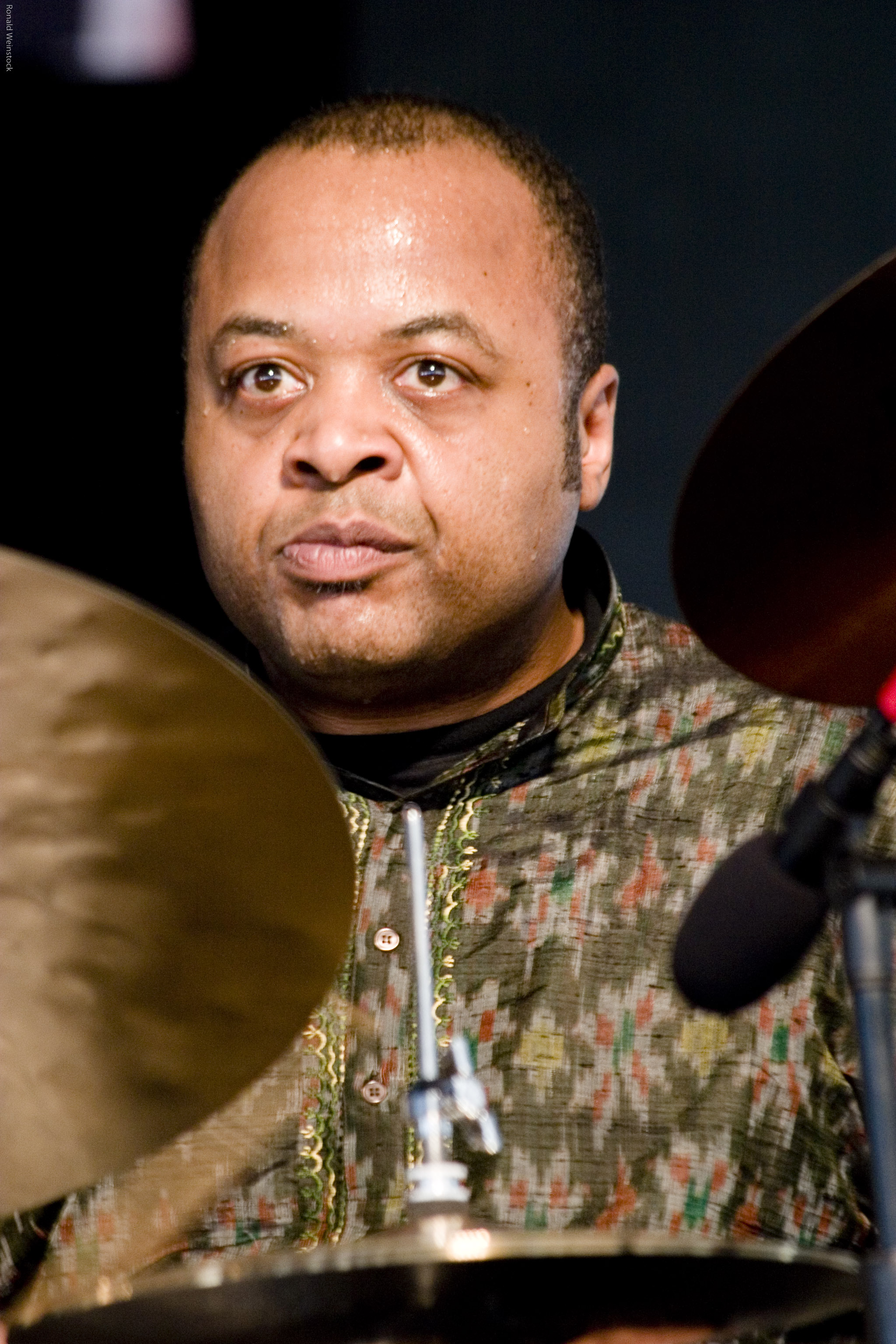
Introduction:
In the heart of the jazz rhythm, where beats are the language and improvisation is the vernacular, stands a maestro who has sculpted sound with his sticks – Jeff “Tain” Watts. Born sixty-four years ago today on January 20, 1960, in Easton, Pennsylvania, Watts has become a legendary figure in the world of jazz, leaving an indelible mark through his drumming prowess and innovative compositions.
Early Beats: From Pennsylvania to Berklee
Watts’ rhythmic journey began in the vibrant town of Easton before converging at Berklee College of Music. His early years were a kaleidoscope of musical influences, from the funk grooves of James Brown to the intricate compositions of Beethoven. The eclectic mix of his musical upbringing became the fertile ground for the unique style that would later define his drumming.
Help yourself to some live jazz, and help the artists and clubs fulfill their dreams. Sign up to Oh! Jazz to watch live and on-demand performances. 25% of your subscription goes back to the artists and 10% to the clubs.
Learn more about Oh! Jazz here.
Moving to Pittsburgh during the Civil Rights movement, Watts found himself immersed in the pulse of the times. His exposure to funk greats and attendance at concerts by musical giants shaped his rhythmic sensibilities. The snare drum became his first canvas, and as he delved into school bands and orchestras, a drumming prodigy was in the making.
Duquesne University provided a classical backdrop for Watts, where the timpani became his muse. The exploration of Beethoven and Stravinsky was juxtaposed with the sounds of Charlie Parker and John Coltrane. The transition from Pittsburgh to Berklee in 1979 was pivotal, marking the beginning of a musical odyssey that would see Watts stand shoulder-to-shoulder with jazz royalty.
From “Tain” to Stardom: A Drummer’s Journey
The moniker “Tain” found its roots during a tour in Florida with Kenny Kirkland. Passing a Chieftain gas station, Watts was anointed with a name that would resonate through the jazz world. His collaboration with Branford Marsalis, sparked by Berklee connections, catapulted him into the epicenter of the jazz renaissance.
Watts’ rhythmic wizardry found expression in the language of the drum set, and his self-taught approach became the canvas for innovation. His journey with Wynton Marsalis resulted in three Grammy Awards, establishing him as a force to be reckoned with. Later collaborations with Branford Marsalis would add two more Grammy Awards to his illustrious collection.
Discography: Drumming Across Genres
Jeff “Tain” Watts’ discography reads like a journey through the diverse landscapes of jazz. From the release of “Megawatts” in 1991 to the profound “Blue, Vol. 2” in 2018, each album is a testament to his evolution as a musician and composer. The rhythmic explorations in “Detained at the Blue Note” and the melodic richness of “Folks Songs” showcase the breadth of his musical palette.
As a sideman, Watts’ collaborations are a who’s who of the jazz world. From Wynton Marsalis and Branford Marsalis to Michael Brecker and Alice Coltrane, his drumming has been the heartbeat of numerous ensembles. His contributions to albums like “Two Blocks from the Edge” with Michael Brecker and “Scenes in the City” with Branford Marsalis underscore his versatility.
The Composer’s Pen: Tain’s Musical Odyssey
A late bloomer as a composer, Watts’ foray into composition was guided by his ears and instincts. Breaking free from the constraints of genre, he embarked on a journey where contemporary classical, jazz, and folkloric influences converged. His compositions are a celebration of freedom, refusing to be confined by musical boundaries.
In the realm of composition, Watts received a Guggenheim fellowship in music composition in 2017. This recognition solidified his place not just as a virtuoso drummer but as a musical thinker pushing the boundaries of jazz expression.
A Drummer’s Drummer: Awards and Accolades
Watts’ contribution to jazz has been duly recognized through a string of Grammy Awards. From “Black Codes From the Underground” in 1985 to “Contemporary Jazz” in 2000, his albums with Wynton Marsalis and the Branford Marsalis Quartet have been celebrated in the jazz community. The Grammy for Best Opera Recording in 2023 for “Fire Shut Up in My Bones” with the Metropolitan Opera added another dimension to his diverse accolades.
The Humanized Polyrhythm: Tain’s Artistic Philosophy
Jeff “Tain” Watts’ approach to drumming goes beyond technical brilliance; it’s a quest to humanize polyrhythm. Using rhythm not just as a structural element but as a medium to convey emotion, Watts’ drumming is a conversation with the listener. He seeks to emulate organic situations and emotion, creating a visceral connection between his art and the audience.
Legacy Beyond the Kit: Tain’s Impact
As a bandleader and musician, Jeff “Tain” Watts’ influence extends beyond the confines of the drum kit. His commitment to expression, innovation, and pushing the boundaries of jazz has left an indelible mark on the genre. The drumming landscape is forever altered by the rhythmic signatures that “Tain” has etched into its fabric.
In a career that spans decades, Jeff “Tain” Watts remains a beacon of rhythmic brilliance. From the streets of Pittsburgh to the grand stages of jazz, his journey is not just a personal narrative but a chapter in the evolving story of jazz. As we listen to the resonant beats of his drums, we are not just hearing a performance; we are witnessing the pulse of a musical era, sculpted by the hands of a true rhythmic architect.
References:
- Gioia, T. (2021). The History of Jazz. Oxford University Press.
- Jeff “Tain” Watts picture. Retrieved from https://en.wikipedia.org/wiki/File:Jeff_Tain_Watts.jpg

Leave a Reply