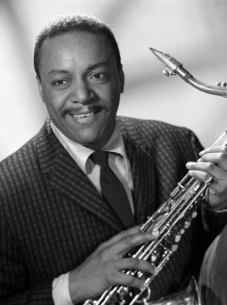
Introduction:
When we talk about jazz greats, certain names consistently rise to the top of our collective consciousness—Coltrane, Rollins, and Hawkins among them. But nestled within the annals of jazz history lies the name Jimmy Forrest, a tenor saxophonist whose soulful, blues-driven approach left an indelible mark on the jazz world. Forrest’s career, which spanned decades and genres, is a testament to the versatility and enduring power of jazz as both an art form and a cultural touchstone.
Early Life and Musical Foundations:
Born one hundred and five years ago today on January 24, 1920, in St. Louis, Missouri, Jimmy Forrest grew up in a city deeply intertwined with the history of blues and jazz. St. Louis was a fertile ground for young musicians, boasting a vibrant music scene that blended the influences of New Orleans jazz, Chicago blues, and the burgeoning swing movement. Forrest’s earliest musical experiences were shaped by this melting pot, which undoubtedly informed his later ability to seamlessly bridge the worlds of jazz and blues.
Help yourself to some live jazz, and help the artists and clubs fulfill their dreams. Sign up to Oh! Jazz to watch live and on-demand performances. 25% of your subscription goes back to the artists and 10% to the clubs.
Learn more about Oh! Jazz here.
During his high school years in St. Louis, Jimmy Forrest honed his craft by collaborating with notable local musicians, including pianist Eddie Johnson, the influential bandleader Fate Marable, and the renowned Jeter-Pillars Orchestra. These early experiences laid the foundation for his professional career. By 1938, Forrest’s burgeoning talent earned him a spot on the road with Don Albert’s orchestra, marking the beginning of his journey into the national jazz scene.
Early Career and Collaborations:
In the early 1940s, Forrest moved to Kansas City, where he joined Jay McShann’s orchestra, a group that also launched the career of Charlie Parker. Forrest’s time with McShann exposed him to a more sophisticated approach to swing and bebop, elements he would incorporate into his playing.
In New York, Jimmy Forrest played with Andy Kirk’s orchestra from 1942 to 1948. This period proved to be a crucial chapter in his career, as it allowed him to refine his ability to navigate intricate arrangements while delivering deeply expressive and soulful solos. During his tenure with Kirk, Forrest cultivated the warm, resonant tone and impeccable rhythmic precision that would later define his distinctive sound and establish him as a master of the tenor saxophone.
“Night Train”: The Defining Hit
Jimmy Forrest achieved widespread fame in 1951 with the release of “Night Train,” a sultry, blues-infused tenor saxophone instrumental that became an instant hit. Built on a riff that had been circulating in the jazz and R&B worlds for years, “Night Train” was transformed by Forrest’s soulful delivery and masterful phrasing.
The track’s infectious groove and simplicity made it a crossover success, appealing to both jazz aficionados and mainstream audiences. It reached No. 1 on the Billboard R&B chart and remains one of the most iconic instrumental recordings in jazz history. Forrest’s rendition of “Night Train” not only cemented his place in jazz lore but also demonstrated his ability to make a timeless standard out of a simple idea.
Duke Ellington:
From 1948 to 1949, Jimmy Forrest played with Duke Ellington’s orchestra before returning to St. Louis. Performing with Ellington demanded unparalleled versatility and sophistication, and Forrest met these demands with remarkable skill. His tenure with the ensemble allowed him to delve into intricate arrangements and expand his mastery of seamlessly blending blues and jazz. Whether interpreting a tender ballad or driving an energetic uptempo piece, Forrest’s commanding tone and lyrical phrasing consistently shone through, leaving an indelible mark on the Ellington legacy.
Leader and Innovator:
In addition to his work as a sideman, Forrest enjoyed a fruitful career as a bandleader, recording numerous albums that showcased his wide-ranging talents. His discography includes standout records like “Forrest Fire” (1960) and “Sit Down and Relax with Jimmy Forrest” (1961), which capture the full spectrum of his artistry—from hard-swinging bebop to deeply expressive blues ballads.
Forrest’s recordings as a leader reveal a musician who was equally at home in small group settings and big band contexts. His playing was marked by an effortless sense of swing, a deep emotional resonance, and an uncanny ability to connect with audiences on a visceral level.
Musical Style and Legacy:
Jimmy Forrest’s style was rooted in the blues, but it also drew from the sophisticated harmonic language of bebop and the lush orchestral textures of swing. His sound was warm and inviting, with a rhythmic drive that made even his ballads feel alive with energy.
Critics and peers alike have praised Forrest’s ability to infuse every note with meaning, whether he was playing a straightforward blues riff or a complex bebop line. This emotional depth, combined with his technical prowess, made him a favorite among fellow musicians and listeners alike.
Though he never achieved the same level of fame as some of his contemporaries, Forrest’s contributions to jazz have been widely recognized in retrospect. He was a musician’s musician, respected for his consistency, adaptability, and unwavering commitment to the music.
Later Years and Passing:
In his later years, Forrest continued to perform and record, remaining an active and vital presence on the jazz scene until his passing. He died on August 26, 1980, leaving behind a rich legacy of recordings and a reputation as one of the most soulful and versatile tenor saxophonists of his generation.
Jimmy Forrest’s career serves as a reminder of the many ways in which jazz musicians have shaped and been shaped by the cultural currents of their time. From his early days in St. Louis to his tenure with Duke Ellington and his success as a bandleader, Forrest consistently pushed the boundaries of what was possible on the tenor saxophone.
His music, particularly the iconic “Night Train,” continues to inspire new generations of listeners and musicians, ensuring that his contributions to jazz will never be forgotten. In a world where the blues and jazz often intersect, Jimmy Forrest remains a shining example of how these two traditions can come together to create something truly timeless.
References:
- DeVeaux, S. & Giddins, G. (2015). Jazz. W. W. Norton & Company.
- Cook, R. & Morton, B. (2008). The Penguin Guide to Jazz Recordings. Penguin Books.
- Yanow, S. (2003). Jazz on Record – The First Sixty Years. Backbeat Books.
- Jimmy Forrest picture. Retrieved from https://en.wikipedia.org/wiki/File:American_jazz_saxophonist_Jimmy_Forrest.png

Leave a Reply