Introduction:
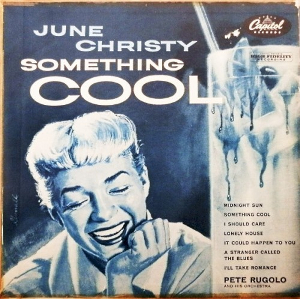
June Christy’s “Something Cool” stands as a seminal album in vocal jazz history, not just for its groundbreaking approach but for the lasting impact it had on the “cool” jazz movement. Originally released as a 10-inch LP in 1954 and later expanded to a 12-inch LP in 1955, “Something Cool” is considered by many to be a masterpiece of modern jazz vocalism, combining June Christy’s unique vocal style with the innovative arrangements of Pete Rugolo. It single-handedly launched Christy’s solo career and cemented her legacy as one of the foremost vocalists of the cool jazz era.
The Background of “Something Cool:”
Before her solo career took off, June Christy was best known as the vocalist for the Stan Kenton Orchestra, where she replaced the legendary Anita O’Day. This was no small feat, as O’Day had become a fan favorite with her rebellious, improvisational style. But Christy was able to carve out her own identity within the Kenton band, establishing a cooler, more reflective approach that was deeply influenced by the “West Coast” jazz scene.
Help yourself to some live jazz, and help the artists and clubs fulfill their dreams. Sign up to Oh! Jazz to watch live and on-demand performances. 25% of your subscription goes back to the artists and 10% to the clubs.
Learn more about Oh! Jazz here.
Christy’s collaborations with Pete Rugolo, Kenton’s former arranger, were integral to her success. Rugolo’s modernist sensibilities, which included intricate harmonies and lush orchestral textures, complemented Christy’s restrained yet emotionally resonant singing. Their partnership was at the heart of “Something Cool,” an album that would define Christy’s sound and set a new standard for jazz vocals in the 1950s.
A Closer Look at the Album:
“Something Cool” was first released in August 1954 as a 10-inch LP featuring seven tracks. The original selections were recorded over several sessions between August 1953 and March 1954. A year later, in August 1955, the album was expanded to a 12-inch LP with four additional tracks, marking the transition from the 10-inch LP format, which was becoming obsolete, to the longer-playing 12-inch format.
What makes “Something Cool” so significant is not just the songs themselves but how Christy performs them. The title track, “Something Cool,” written by Billy Barnes, immediately became Christy’s signature song. It tells the story of a woman sitting at a bar, reminiscing about better days and subtly hinting at her personal struggles. Christy’s delivery is wistful, restrained, and emotionally nuanced, perfectly capturing the sense of lost dreams and fading glamour. The song, which became a standard for Christy throughout her career, exemplifies her ability to inhabit a character through song, bringing a sense of narrative to her performance.
The album also includes several other standout tracks. “It Could Happen to You,” written by Jimmy Van Heusen and Johnny Burke, is a swinging, light-hearted number that showcases Christy’s ability to handle upbeat material with ease. On the more introspective side, “Lonely House,” composed by Kurt Weill with lyrics by Langston Hughes, is a haunting exploration of isolation and despair. Christy’s interpretation of the song is both delicate and deeply moving, highlighting her ability to convey complex emotions without over-singing.
Other highlights include “Midnight Sun,” a song that features lyrics by Johnny Mercer and music by Lionel Hampton and Sonny Burke. This track has been widely regarded as one of the finest examples of jazz balladry, and Christy’s performance does it full justice. Her voice glides effortlessly over Rugolo’s intricate arrangement, creating a mesmerizing, dreamlike atmosphere. Rugolo’s arrangements are a key component of the album’s success. He brings a level of sophistication and depth to the music that elevates Christy’s vocals.
The 1960 Re-recording and Legacy:
In 1960, Capitol Records decided to re-record the entire album in stereophonic sound, capitalizing on the growing popularity of stereo recordings. This re-recording involved many of the same musicians and featured the same track listing as the 1955 version, but with new stereo arrangements by Rugolo. For many years, this stereo version was the only commercially available edition of the album, and it became the version that most listeners were familiar with.
In 1991, “Something Cool” was reissued on compact disc, featuring 13 bonus tracks from various sessions between 1953 and 1955. However, this reissue controversially presented the songs in the order they were recorded, rather than the original running order of the album. In 2001, a further reissue corrected this by restoring the original sequence of the 1955 album and including both the mono and stereo versions. The 2001 edition, remastered with 24-bit Super Bit Mapping, is widely regarded as the definitive version of the album.
Critically, “Something Cool” has garnered praise since its release. It received a rare “crown” rating in “The Penguin Guide to Jazz Recordings,” an accolade reserved for only the finest jazz albums. Will Friedwald, one of the foremost authorities on jazz and pop vocals, included “Something Cool” on his list of desert island discs in the 1996 edition of “Jazz Singing,” and in his 2010 book, “A Biographical Guide to the Great Jazz and Pop Singers,” he called it “closer to being a perfect album, in every respect, than most of the albums made by superior jazz singers, like O’Day and Fitzgerald.”
Reception and Influence:
“Something Cool” was a commercial success upon its release. The original 10-inch album peaked at #8 on the Billboard Best-Selling Popular Albums chart in January 1955, an impressive feat for a debut solo album. It is widely credited with popularizing the cool jazz vocal style, which emphasized restraint, subtlety, and emotional depth over the more exuberant, virtuosic styles that had dominated vocal jazz in the 1940s.
Christy’s influence extended beyond the jazz world. Her cool, sophisticated persona and nuanced performances helped shape the direction of vocal music in the 1950s and beyond. Artists like Julie London, Peggy Lee, and even Frank Sinatra would later adopt elements of the cool jazz style, and Christy’s work continues to be revered by contemporary jazz vocalists.
The Cool Jazz Movement:
At the time of the album’s release, the cool jazz movement was beginning to take shape on the West Coast, where musicians like Chet Baker, Gerry Mulligan, and Dave Brubeck were exploring a more relaxed, introspective approach to jazz. Christy’s work with Stan Kenton had already positioned her as one of the leading voices in this emerging style, and “Something Cool” solidified her role as the first major vocalist to fully embrace cool jazz.
While other vocalists such as Anita O’Day and Ella Fitzgerald were known for their vocal pyrotechnics and scat singing, Christy’s approach was more subdued. She prioritized tone, phrasing, and emotional interpretation, often letting the lyrics speak for themselves rather than relying on vocal acrobatics. This focus on mood and atmosphere aligned perfectly with the ethos of cool jazz, which valued subtlety and emotional depth over showmanship.
“Something Cool” remains a timeless masterpiece of jazz vocalism. June Christy’s ability to convey deep emotion with restraint and sophistication, combined with Pete Rugolo’s innovative arrangements, make the album a landmark of the cool jazz movement. Its influence can still be felt in the work of contemporary jazz vocalists, and it continues to captivate listeners with its timeless beauty and elegance. Whether you’re a longtime jazz aficionado or a newcomer to the genre, “Something Cool” is an essential listening experience that showcases the very best of what jazz vocals have to offer.
References:
- Friedwald, W. (2010). A Biographical Guide to the Great Jazz and Pop Singers. Pantheon.
- Cook, R. & Morton, B. (2008). The Penguin Guide to Jazz Recordings. Penguin Books.
- “Something Cool” album cover art. Retrieved from https://en.wikipedia.org/wiki/File:Something_Cool.jpg

Leave a Reply