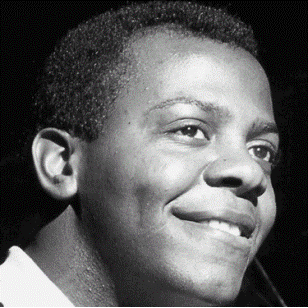
Introduction:
Larry Young, often regarded as the “John Coltrane of the organ,” was a pivotal figure in the evolution of jazz organ. His unique sound and visionary approach transformed the role of the organ in jazz, shifting it away from the traditional groove-oriented style and into a more harmonically adventurous and experimental realm. Over a career that spanned from the early 1960s until his untimely death in 1978, Young’s contributions reshaped not only how the organ was perceived in jazz but also opened the door to a broader fusion of musical genres. This blog post delves into his life, his groundbreaking albums, and his lasting legacy.
Early Life and Influences:
Larry Young was born eighty-four years ago today on October 7, 1940, in Newark, New Jersey. He attended Newark Arts High School, where his musical talents flourished as he performed with both a vocal group and a jazz band. Young’s musical lineage ran deep—he was the cousin of renowned drummer Jimmie Smith. In the 1950s, Young gained experience playing with various R&B bands, but his jazz credentials soon developed as he performed alongside legends like Jimmy Forrest, Lou Donaldson, Kenny Dorham, Hank Mobley, and Tommy Turrentine.
Help yourself to some live jazz, and help the artists and clubs fulfill their dreams. Sign up to Oh! Jazz to watch live and on-demand performances. 25% of your subscription goes back to the artists and 10% to the clubs.
Learn more about Oh! Jazz here.
The Early Albums: Finding His Voice
Young’s early recordings in the 1960s reflect his efforts to blend traditional organ styles with more modern jazz sensibilities. His debut album, “Testifying” (1960), released on Prestige Records, is steeped in the soul-jazz tradition. It features the classic groove-oriented sound that organists like Jimmy Smith had popularized. While impressive, it did not yet reveal the innovative spirit that would soon define his music.
Over the next few years, Young released “Young Blues” (1960) and “Groove Street” (1962), both of which showed him developing his craft but still adhering closely to the mainstream organ jazz formula. However, it was during this period that Young began expanding his harmonic vocabulary and experimenting with modal jazz, inspired by Miles Davis’ “Kind of Blue” and John Coltrane’s “Giant Steps.”
Breaking New Ground: “Unity” (1966)
The turning point in Larry Young’s career came with his move to Blue Note Records in 1964 and the release of “Unity.” Widely regarded as one of the greatest jazz albums of all time, “Unity” marked a dramatic shift in the jazz organ tradition. It broke away from the hard-swinging, blues-based approach of his earlier work and embraced modal improvisation and complex harmonies, positioning the organ as a more textural, atmospheric instrument.
The album featured a stellar lineup, including Woody Shaw on trumpet, Joe Henderson on tenor saxophone, and Elvin Jones on drums. With this ensemble, Young crafted an album that not only highlighted his innovative playing but also presented a cohesive group dynamic. Tracks like “Zoltan” and “The Moontrane” (both composed by Shaw) displayed a profound sense of exploration, mixing elements of hard bop, post-bop, and modal jazz.
On “Unity,” Young used the organ in a way that had never been heard before. Instead of relying on heavy riffs and blues scales, he created dense harmonic clusters and shimmering, sustained tones. His improvisations were cerebral and harmonically advanced, often drawing comparisons to McCoy Tyner’s piano work with Coltrane. The influence of John Coltrane’s “A Love Supreme” is particularly notable in Young’s layered approach to harmony.
“Unity” was a statement of purpose. It was a declaration that the organ could be more than a groove instrument—it could be a tool for advanced harmonic exploration, just like the piano or saxophone.
Collaborations and the Fusion Era:
In the late 1960s and early 1970s, Young’s career took another turn as he ventured into the burgeoning jazz-rock fusion scene. He played a significant role in Tony Williams’ groundbreaking group, “Lifetime,” alongside guitarist John McLaughlin. The trio’s album “Emergency!” (1969) is a cornerstone of jazz-rock fusion, blending rock, jazz, and experimental music in a way that pushed the boundaries of both genres.
With “Emergency!,” Young demonstrated a versatility that few organists had achieved. His sound, by this time, was cosmic and otherworldly, incorporating dissonance, unconventional chord structures, and polyrhythmic patterns. The organ, in Young’s hands, became a vehicle for sonic exploration, a far cry from its traditional jazz role. In Lifetime, Young was less concerned with following the established rules of jazz and more interested in sonic innovation and boundary-pushing.
This period also saw Young collaborate with other pioneering musicians, including contributions to Miles Davis’ fusion masterpiece “Bitches Brew” (1970). Young’s work on the album, though not as prominent as some of his other projects, contributed to the album’s thick, layered textures and avant-garde approach to jazz-rock.
Later Work and Legacy:
As the 1970s progressed, Young continued to push the boundaries of his instrument. His albums from this period, such as “Lawrence of Newark” (1975), reflect his deepening interest in free jazz, spiritual jazz, and the avant-garde. “Lawrence of Newark,” in particular, is a fascinating document of Young’s spiritual and artistic evolution, blending Middle Eastern scales, African rhythms, and abstract soundscapes. It was a bold and uncompromising record, further cementing Young’s reputation as a musical visionary.
Though his later career was marked by periods of relative obscurity, Young’s influence continued to grow. His willingness to experiment, his rejection of traditional structures, and his innovative approach to the organ have been acknowledged by generations of musicians.
Tragically, Young’s life was cut short in 1978, when he died under mysterious circumstances at the age of 37. Despite his premature death, his contributions to jazz, especially his pioneering use of the organ, remain deeply influential.
Larry Young’s career was one of bold innovation and relentless exploration. From his early days in the hard-bop scene to his transformative work in modal jazz and fusion, Young never shied away from pushing the boundaries of his instrument and the genre. His willingness to challenge the norms of jazz organ playing, and his integration of complex harmonies and textures, reshaped how the organ could function within the jazz idiom.
For jazz enthusiasts and musicians, Larry Young’s work represents a masterclass in innovation and artistic courage. His journey from soul-jazz grooves to avant-garde fusion continues to inspire musicians who seek to break free from tradition and carve their own paths in the ever-evolving landscape of jazz. Young may have left this world far too soon, but his music continues to resonate, ensuring his place as one of jazz’s true trailblazers.
References:
- Yanow, S. (2003). Jazz on Record – The First Sixty Years. Backbeat Books.
- Feather, L. & Gitler, I. (2007). The Biographical Encyclopedia of Jazz. Oxford University Press.
- Larry Young picture. Retrieved from https://en.wikipedia.org/wiki/File:Larry_Young_(musician).gif
.gif)
Leave a Reply