Introduction:
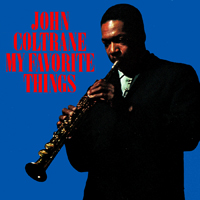
In the expansive realm of jazz, few albums have reached the cultural significance and enduring impact of John Coltrane’s “My Favorite Things.” Released in March 1961, this seminal recording marked a pivotal moment in Coltrane’s career, both as an artist pushing the boundaries of jazz and as a musician breaking through to a broader audience. From its revolutionary modal interpretations to the introduction of Coltrane’s soprano saxophone sound, “My Favorite Things” remains one of jazz’s most celebrated achievements.
The Genesis of a Classic:
By the time Coltrane recorded “My Favorite Things,” his artistic trajectory was soaring to new heights. Having recently departed from the Miles Davis Quintet—a tenure during which he refined his mastery of modal jazz, most notably on the groundbreaking “Kind of Blue” (1959)—Coltrane was poised for innovation. While on tour in Europe with Davis in March 1960, Davis purchased a soprano saxophone for Coltrane, an instrument that had largely faded from modern jazz since the era of Sidney Bechet. With its piercing yet fluid tone, the soprano saxophone quickly became a defining element of Coltrane’s sound, debuting prominently on this album and shaping his music for years to come.
Help yourself to some live jazz, and help the artists and clubs fulfill their dreams. Sign up to Oh! Jazz to watch live and on-demand performances. 25% of your subscription goes back to the artists and 10% to the clubs.
Learn more about Oh! Jazz here.
Later that summer, Coltrane formed his first classic quartet, solidifying a lineup featuring McCoy Tyner on piano, Steve Davis on bass, and Elvin Jones on drums. The quartet began exploring modal frameworks and freer forms of improvisation during their regular gigs at New York’s Jazz Gallery, culminating in the late October recording sessions that produced “My Favorite Things.”
A Revolutionary Interpretation of a Broadway Standard:
The album’s title track, an audacious reimagining of the Rodgers and Hammerstein tune from “The Sound of Music,” occupies a central place in the jazz canon. In Coltrane’s hands, this Broadway melody is transformed into a modal jazz masterpiece.
Rather than adhering to the song’s original harmonic progression, Coltrane and Tyner stripped it down to two alternating chords—E minor and E major—played over a hypnotic waltz rhythm. This minimalist approach provided a spacious framework for Coltrane’s improvisations, allowing him to delve into serpentine melodic variations and explore Eastern-influenced phrasing. The result is a piece that transcends its show-tune origins, taking on an almost meditative quality.
The recording’s reception was immediate and profound. An edited version of the track became a hit on radio, bringing Coltrane mainstream recognition. In the 1990 documentary “The World According to John Coltrane,” narrator Ed Wheeler observed that the track “became Coltrane’s most requested tune—and a bridge to broad public acceptance.”
The Quartet in Peak Form:
The rest of the album showcases the formidable interplay of Coltrane’s quartet. On Cole Porter’s “Ev’ry Time We Say Goodbye,” Coltrane delivers a plaintive soprano saxophone performance, underscored by Tyner’s lyrical piano accompaniment. The piece is a study in restraint, highlighting Coltrane’s ability to convey emotion through subtle tonal shifts.
The second side of the record shifts to Coltrane’s tenor saxophone, with two tracks emphasizing his virtuosity and innovative approach to harmony. On George Gershwin’s “Summertime,” Coltrane’s deep, resonant tone imbues the piece with a bluesy intensity, while his solos weave through the harmonic structure with an effortless sense of exploration.
The closing track, “But Not for Me,” exemplifies Coltrane’s mastery of reharmonization. Employing his signature “Coltrane changes”—a harmonic technique first explored on “Giant Steps” (1960)—he transforms the Gershwin standard into a complex, high-energy tour de force.
Production and Release:
Produced by Nesuhi Ertegün and engineered by Tom Dowd, the album was recorded over three sessions at Atlantic Studios in New York. These sessions were remarkably productive, also yielding material for “Coltrane Jazz” (1961), “Coltrane Plays the Blues” (1962), and “Coltrane’s Sound” (1964).
Released in March 1961 on Atlantic Records, “My Favorite Things” was an instant commercial success. Its accessibility—owing to the title track’s familiarity—helped introduce a wider audience to Coltrane’s more adventurous musical ideas. The album was reissued in 1998 by Rhino Records, featuring bonus tracks that included the edited single version of “My Favorite Things.”
Reception and Legacy:
Critical acclaim for “My Favorite Things” has only grown over time. In 1998, the album was inducted into the Grammy Hall of Fame, and in 2018, it achieved gold certification from the Recording Industry Association of America (RIAA). Critics have hailed it as a turning point in Coltrane’s career, bridging his work in modal jazz with the freer, more experimental directions he would later pursue.
Colin Larkin ranked it among the top 1,000 albums of all time in his 2000 book, “All Time Top 1000 Albums.” The Penguin Guide to Jazz lauded the quartet’s intuitive interplay, while Rolling Stone praised the album’s “practically casual” approach to groundbreaking artistry.
Cultural Impact:
The title track’s success marked a shift in the public’s perception of Coltrane. While he had already established himself as a prominent figure in jazz, “My Favorite Things” broadened his audience, attracting listeners who might not have otherwise ventured into the genre.
Moreover, the album’s modal approach and Eastern influences presaged Coltrane’s later explorations in spiritual jazz, as heard on albums like “A Love Supreme” (1965). It also inspired countless musicians to rethink the possibilities of jazz improvisation, from its harmonic frameworks to its rhythmic structures.
“My Favorite Things” is much more than an album—it is a landmark in the history of jazz and a testament to John Coltrane’s genius. By reimagining familiar standards through the lens of modal jazz, Coltrane not only expanded the boundaries of the genre but also created a work of art that continues to captivate listeners more than six decades later.
As we revisit “My Favorite Things” today, we are reminded of Coltrane’s ability to blend technical innovation with profound emotional resonance, making it one of the most enduring albums in jazz history.
References:
- Porter, L., DeVito, C., Wild, D., Fujioka, Y., & Schmaler, W. (2013). The John Coltrane Reference. Routledge.
- Porter, L. (2000). John Coltrane: His Life and Music. University of Michigan Press.
- Ratliff, B. (2008). Coltrane: The Story of a Sound. Picador.
- Larkin, C. (2000). All-Time Top 1000 Albums. London Bridge.
- Swenson, J. (1985). Rolling Stone Jazz Record Guide. Random House.
- “My Favorite Things” album cover art. Retrieved from https://en.wikipedia.org/wiki/File:My_Favorite_Things.jpg

Leave a Reply