Introduction:
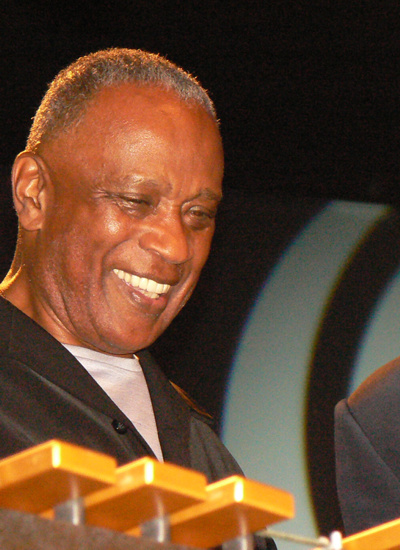
In jazz history, several figures emerge not only as brilliant instrumentalists but also as sound innovators who form the genre’s soul. Bobby Hutcherson, born eighty-three years ago today, on January 27, 1941, in Los Angeles, California, is one such luminary whose mastery of the vibraphone and marimba exceeded traditional limits, leaving an indelible mark on the landscape of modern jazz.
Early Cadence: A Prodigy’s Awakening
From the early echoes of his childhood, it was apparent that Hutcherson was destined for a life in music. Raised in a household where melodies wafted through the air, he found his rhythm with the vibraphone. Influenced by the melodic vibes of Milt Jackson, Hutcherson’s journey into the heart of jazz began.
Help yourself to some live jazz, and help the artists and clubs fulfill their dreams. Sign up to Oh! Jazz to watch live and on-demand performances. 25% of your subscription goes back to the artists and 10% to the clubs.
Learn more about Oh! Jazz here.
Blue Note Records: Forging a Sonic Legacy
Hutcherson’s ascent to prominence aligned with a period of seismic innovation in jazz. Signing with the illustrious Blue Note Records in the early 1960s, he became a linchpin in the vanguard of musicians pushing the boundaries of hard bop and modal jazz. Collaborations with giants like Jackie McLean, Eric Dolphy, and Andrew Hill marked the genesis of a revolutionary voice.
The groundbreaking album “Out to Lunch!” (1964), led by Eric Dolphy, stands as a testament to Hutcherson’s prowess. His vibraphone added an ethereal quality to the avant-garde landscape, challenging conventions and ushering in a new era of sonic exploration.
Vibraphonic Alchemy: Shaping Jazz’s DNA
Hutcherson’s approach to the vibraphone was nothing short of alchemy. His playing was not a mere string of notes; it was a transformative experience. The album “Dialogue” (1965), a collaboration with pianist Andrew Hill, showcases Hutcherson’s ability to weave intricate dialogues through his vibes. The title track, “Dialogue,” emerges as a sonic journey, an interplay of musical voices that defied traditional structures.
Navigating Uncharted Harmonies:
As jazz delved into new territories in the 1960s, Hutcherson emerged as a trailblazer in navigating these uncharted harmonic landscapes. His contributions to Joe Henderson’s “Mode for Joe” (1966) epitomize his ability to traverse complex structures while retaining a melodic sensibility. Hutcherson’s vibes became a defining force in the lexicon of jazz, influencing subsequent generations of vibraphonists.
Collaborative Symphony: A Jazz Artisan’s Palette
Hutcherson’s artistic palette extended beyond solo ventures. His collaborations painted a vivid symphony of sounds. Explorations with McCoy Tyner and avant-garde adventures with Archie Shepp showcased his versatility. His work with the cooperative ensemble ‘SFJAZZ Collective’ in the 2000s demonstrated that Hutcherson’s artistic flame burned as brightly as ever.
Harmonic Legacy and Cultural Impact:
Bobby Hutcherson’s impact reached well beyond the boundaries of jazz purists, resonating in realms far broader than the aficionados of the genre. In addition to his groundbreaking musical career, Hutcherson dabbled in acting, leaving an indelible mark on the cinematic landscape. Notably, he assumed the role of the bandleader in “They Shoot Horses, Don’t They?” (1969), providing a cinematic backdrop to his multifaceted talents. Furthermore, his portrayal of Ace in “Round Midnight” (1986) showcased his versatility, proving that Hutcherson’s artistic expression wasn’t confined to the harmonic realms of jazz but extended seamlessly into the visual and narrative dimensions of film.
Legacy Beyond Sound: A Lasting Influence
Bobby Hutcherson’s departure from the mortal realm in 2016 marked the end of a chapter, but his legacy endures. His sonic alchemy inspires a new generation of musicians, vibraphonists, and jazz enthusiasts. The spirit of exploration, the commitment to innovation, and the dedication to pushing harmonic boundaries—all hallmarks of Hutcherson’s artistry—live on.
Bobby Hutcherson’s journey through the realms of jazz was a harmonic odyssey. From the resonant vibes of his childhood to the groundbreaking explorations at Blue Note, and the collaborative symphonies that echoed through the decades, Hutcherson crafted sonic landscapes that transcend time. His vibraphonic alchemy remains an integral part of jazz’s DNA, ensuring that the name Bobby Hutcherson resounds as a testament to the limitless possibilities of artistic expression in the ever-evolving tapestry of jazz.
References:
- Gioia, T. (2021). The History of Jazz. Oxford University Press.
- Bobby Hutcherson picture. Retrieved from https://en.wikipedia.org/wiki/File:Bh_070701.jpg

Leave a Reply