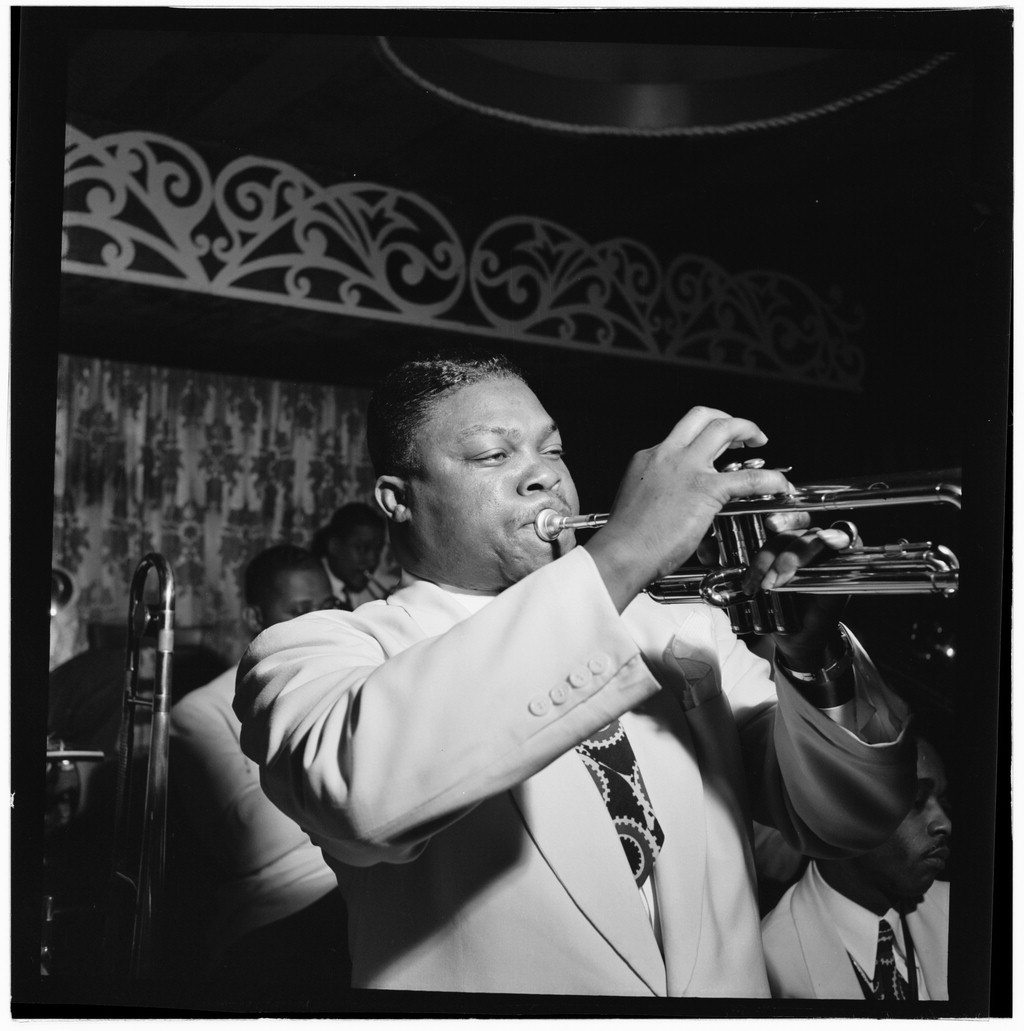
Introduction:
William “Cat” Anderson, born one hundred and eight years ago today on September 12, 1916, in Greenville, South Carolina, is best remembered for his explosive trumpet range and his remarkable ability to hit incredibly high notes with precision and flair. A key figure in Duke Ellington’s orchestra, Anderson’s contributions to jazz not only redefined trumpet playing but also left an indelible mark on big band music during the 20th century.
In this post, we will explore the life and career of Cat Anderson, from his beginnings as a young orphan with a musical gift to his international reputation as a jazz innovator, as well as the techniques that made him a revered figure in jazz history.
Early Life and Musical Beginnings:
Help yourself to some live jazz, and help the artists and clubs fulfill their dreams. Sign up to Oh! Jazz to watch live and on-demand performances. 25% of your subscription goes back to the artists and 10% to the clubs.
Learn more about Oh! Jazz here.
Cat Anderson’s life began under challenging circumstances. After losing both of his parents at the age of four, Anderson was sent to the Jenkins Orphanage in Charleston, South Carolina. It was here that Anderson’s musical journey took off, as the orphanage had a well-regarded brass band program. Anderson learned to play the trumpet and quickly excelled, catching the attention of local audiences with his developing skills.
The Jenkins Orphanage band wasn’t just any ordinary school ensemble. It provided music education to African-American children in the early 20th century and was a proving ground for future jazz greats, including Anderson. The band toured extensively, performing in parades and festivals up and down the East Coast, which gave young Anderson his first taste of life as a professional musician.
His classmates dubbed him “Cat,” a nickname he would carry throughout his life, in recognition of his agile and tenacious nature, both in and out of music. After leaving the orphanage at 18, Anderson joined several touring bands, where he continued to refine his trumpet technique and broaden his musical horizons, setting the stage for his future in jazz.
Career Breakthrough with Duke Ellington:
Anderson’s big break came in 1944 when he was invited to join Duke Ellington’s legendary orchestra. At the time, Ellington’s band was one of the most prestigious ensembles in the world, and Anderson’s entry into the group marked the beginning of a new phase in his career.
With Ellington, Anderson was able to showcase his unique talent for high-note trumpet playing. His ability to hit notes in the stratosphere with remarkable ease quickly set him apart from other trumpeters of the era. Anderson became a featured soloist in the band, and his high-register playing added an exciting new dimension to Ellington’s arrangements.
One of the most famous examples of Anderson’s work with Ellington is his performance on “Satin Doll,” where his piercing high notes became an integral part of the song’s sound. Anderson was also featured prominently in Ellington’s suite “Such Sweet Thunder” (1957), as well as on countless other recordings.
But Anderson was more than just a high-note specialist. His versatility allowed him to adapt to a wide range of musical styles, from Ellington’s lush ballads to up-tempo swing numbers. His contribution to the band’s brass section was vital in maintaining the orchestra’s cutting-edge sound throughout the 1940s and 1950s.
A Pioneer of Trumpet Technique:
What made Cat Anderson so special was not only his extraordinary range but also his mastery of trumpet technique. Anderson developed a unique method of playing that allowed him to sustain high notes for extended periods without losing power or tone quality. He was known to practice for hours each day, working on embouchure strength and breath control.
Anderson’s embouchure technique, in particular, became the stuff of legend. Trumpet players marveled at his ability to control the muscles around his mouth to produce the incredibly high and powerful notes that had become his signature. His playing inspired generations of trumpet players to experiment with their own technique in pursuit of similar results.
His innovative use of the “scream” trumpet—where the instrument is played at its absolute upper limit of range and volume—paved the way for future generations of high-note specialists in jazz, including players like Maynard Ferguson and Jon Faddis.
Beyond the technical side, Anderson had a deep understanding of dynamics and phrasing. He could move seamlessly from a whisper-soft melody to a roof-raising explosion of sound, often within the same solo. This made him an invaluable asset to Ellington’s orchestra and contributed to his lasting reputation as a trumpeter who pushed the limits of the instrument.
More than just a master of high notes, Anderson also excelled in the nuanced techniques of half-valve playing and the use of the plunger mute. As Duke Ellington’s go-to utility trumpeter, Anderson was invaluable to the band, seamlessly stepping in to cover any missing parts, demonstrating his remarkable versatility and command over his instrument.
Work Outside Ellington’s Orchestra:
Although Anderson is most famous for his work with Duke Ellington, he also enjoyed a successful career as a bandleader and session musician. Throughout the 1950s and 1960s, Anderson recorded several albums under his own name, showcasing his range as a composer and bandleader. Albums like “Cat on a Hot Tin Horn” (1958) and “Cat Speaks” (1977) allowed him to step out of Ellington’s shadow and explore his own musical ideas.
He also worked as a sideman for many other prominent jazz artists, including Lionel Hampton and Claude Hopkins. His versatility and distinctive sound made him a sought-after player for both studio recordings and live performances.
Later Years and Legacy:
Cat Anderson continued to perform well into the 1970s, though his career slowed as the big band era came to an end. However, his contributions to jazz continued to be recognized by critics and fellow musicians alike. He remained an active figure in the jazz scene until his death on April 29, 1981, in Los Angeles, California.
Anderson’s legacy as a trumpet player is defined by his technical mastery and his ability to innovate within the jazz tradition. He pushed the boundaries of what was thought possible on the trumpet, and his influence can be heard in the work of countless trumpet players who followed him.
His time with Duke Ellington alone would have been enough to secure his place in jazz history, but Anderson’s work as a solo artist and session musician further cemented his reputation as one of the greats. His recordings continue to be studied and celebrated by jazz enthusiasts and trumpet players around the world.
Cat Anderson’s extraordinary career serves as a testament to the power of innovation and dedication in the world of jazz. His ability to hit and sustain high notes on the trumpet, combined with his deep understanding of musical dynamics and phrasing, made him a unique and influential figure in jazz history. As a key member of Duke Ellington’s orchestra, he helped shape the sound of one of the most important ensembles in jazz, and his contributions to trumpet technique have left a lasting legacy that continues to inspire musicians today.
While Anderson may not be as widely recognized as some of his contemporaries, his contributions to jazz trumpet playing are undeniable. His influence can still be felt in the work of modern trumpeters, and his recordings remain a vital part of the jazz canon. In the world of jazz, few musicians have pushed the limits of their instruments as far as Cat Anderson did, and for that, he deserves to be remembered as one of the true innovators of the art form.
References:
- Teachout, T. (2013). Duke: A Life of Duke Ellington. Avery.
- Hasse, J.E. (1995). Beyond Category: The Life And Genius Of Duke Ellington. Da Capo Press.
- Lambert, E. (1998). Duke Ellington: A Listener’s Guide. Scarecrow Press.
- Cat Anderson picture. Retrieved from https://en.wikipedia.org/wiki/File:Cat_Anderson,_Aquarium,_New_York,_N.Y.,_between_1946_and_1948_(William_P._Gottlieb_00081).jpg
.jpg)
Leave a Reply