Introduction:
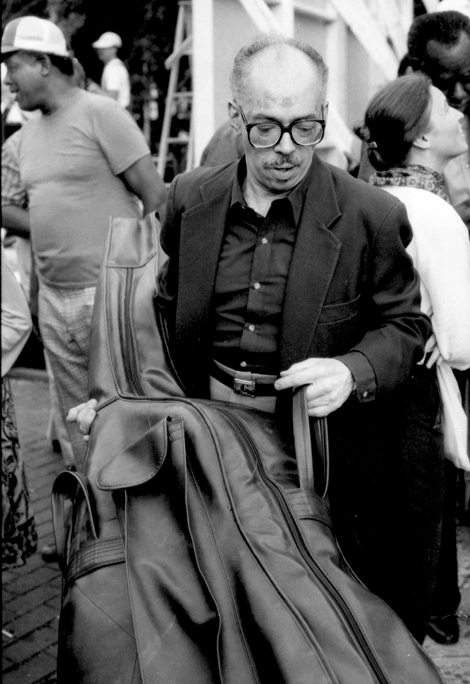
Jazz is a genre rich with virtuosos who have transformed the soundscape with their distinctive styles and techniques. However, some of these virtuosos, despite their monumental contributions, remain less celebrated than their peers. One such figure is George Duvivier, a master of the double bass whose career spanned over four decades, leaving an indelible mark on the jazz world.
Early Life and Musical Beginnings:
George Duvivier was born one hundred and four years ago today on August 17, 1920, in New York City, a city that would become a central hub in his life and career. He was the son of Leon V. Duvivier and Ismay Blakely Duvivier. Music flowed in his veins from an early age, and he began his musical journey with the violin. Duvivier attended the Conservatory of Music and Art, where he honed his skills and eventually became the assistant concertmaster for the Central Manhattan Symphony Orchestra at the young age of 16.
Help yourself to some live jazz, and help the artists and clubs fulfill their dreams. Sign up to Oh! Jazz to watch live and on-demand performances. 25% of your subscription goes back to the artists and 10% to the clubs.
Learn more about Oh! Jazz here.
However, his musical path took a decisive turn when he switched to the double bass, an instrument that would become his lifelong companion. This transition marked the beginning of Duvivier’s deep involvement in the jazz world. He also studied composition at New York University, a discipline that would later play a significant role in his career as both a bassist and an arranger.
The 1940s: A Rising Star
Duvivier’s professional career began in the early 1940s, during a period of significant evolution in jazz. He first gained recognition as a bassist while playing with jazz luminaries such as Coleman Hawkins, Lucky Millinder, and Eddie Barefield. These early experiences allowed him to develop his technique and adaptability, skills that would serve him well throughout his career.
The outbreak of World War II saw Duvivier serving in the U.S. Army. After his discharge, he returned to the music scene with a renewed focus, this time adding arranging to his repertoire. He became a staff arranger for the legendary Jimmie Lunceford from 1945 to 1947, a role that highlighted his compositional skills. Following this, he joined Sy Oliver’s big band, where he served both as a bassist and arranger. This period established Duvivier as a versatile and reliable musician, capable of handling multiple roles with finesse.
The 1950s: Touring and Recording
The 1950s were a prolific period for Duvivier, marked by extensive touring and recording. He accompanied the iconic singer Lena Horne on her European tour, further solidifying his reputation as a dependable sideman. His ability to adapt to different musical contexts made him a sought-after bassist for both live performances and studio sessions.
During this decade, Duvivier also ventured into the realm of film and television, recording soundtracks and commercial jingles. Despite his growing fame, he remained primarily a sideman, a role he embraced with professionalism and dedication. In 1956, he made a rare appearance as a bandleader, recording an album with French pianist Martial Solal for the Coronet label. This project, though not widely known, showcased Duvivier’s leadership abilities and his deep understanding of jazz.
One of the most pivotal collaborations in Duvivier’s career unfolded between 1953 and 1957, during which he worked extensively with the legendary Bud Powell. Their partnership flourished in live performances, with Duvivier’s bass offering a steadfast, rhythmic backbone that empowered Powell’s piano to ascend to new heights.
Versatility and Collaborations:
George Duvivier’s versatility was one of his greatest strengths. He was equally comfortable playing swing, bop, cool jazz, and even more avant-garde styles. His adaptability made him a favorite among bandleaders, and he worked with a veritable who’s who of jazz greats, including Count Basie, Benny Carter, Benny Goodman, Chico Hamilton, Hank Jones, Shelly Manne, Oliver Nelson, Frank Sinatra, Clark Terry, Ben Webster, and Bob Wilber.
Duvivier’s ability to play fast, intricate passages in the upper register of the bass, while maintaining a deep, resonant tone in the lower register, set him apart from many of his contemporaries. He was a master of both solo and ensemble playing, able to shine in a variety of settings. His work with Eric Dolphy, for example, demonstrated his willingness to explore the boundaries of jazz, while his sessions with Frank Sinatra highlighted his capacity for elegant, understated accompaniment.
Later Years and Legacy:
The 1960s and 1970s saw Duvivier continuing to contribute to a wide range of projects. He played on numerous albums, often serving as the glue that held together the disparate elements of a recording session. His work during this period included collaborations with Art Farmer, Dizzy Gillespie, Wes Montgomery, Oliver Nelson, and Sarah Vaughan, among many others.
One of the remarkable aspects of Duvivier’s career was his ability to seamlessly transition between different roles and musical contexts. Whether playing in a small combo, a big band, or a studio orchestra, he brought the same level of commitment and artistry to his work. His deep understanding of music, coupled with his technical prowess, made him an invaluable asset to any ensemble.
In the 1980s, as he approached the end of his life, Duvivier continued to play and record, remaining active until his death on July 11, 1985. He passed away in New York City, the city that had shaped his career and where he had made his greatest contributions to the world of jazz.
George Duvivier’s Discography:
George Duvivier’s discography is extensive, reflecting the breadth of his collaborations and the diversity of his musical engagements. Some of the notable albums he contributed to include:
- With Coleman Hawkins: “Coleman Hawkins and Confrères” (1958), “Hawk Eyes” (1959)
- With Eric Dolphy: “Out There” (1961)
- With Lena Horne: “Stormy Weather” (1957), “Lena on the Blue Side” (1962)
- With Count Basie: “High Voltage” (1970)
- With Oliver Nelson: “Straight Ahead” (1961), “The Kennedy Dream” (1967)
- With Bud Powell: “The Amazing Bud Powell Vol. 2” (1954)
- With Sarah Vaughan: “Dreamy” (1960), “¡Viva! Vaughan” (1965)
Duvivier’s ability to contribute meaningfully to such a wide array of projects is a testament to his skill and musical sensitivity. His work, though often under the radar, was essential in shaping the sound of many classic recordings.
Legacy and Influence:
Despite his extensive body of work and his contributions to countless recordings, George Duvivier remains somewhat of an unsung hero in the jazz world. His name may not be as widely recognized as some of his contemporaries, but his influence is deeply felt by those who appreciate the art of jazz bass playing.
Duvivier’s style has influenced many bassists who came after him, particularly in his use of the upper register and his rhythmic precision. His ability to blend into an ensemble while still making a significant musical impact is a quality that many musicians strive to achieve.
Moreover, Duvivier’s dedication to his craft and his professionalism set a high standard for musicians across all genres. He was a consummate sideman, always ready to support the music and enhance the performance of those around him. His career serves as a reminder that in jazz, as in life, true greatness is not always about being in the spotlight, but about making a lasting contribution through talent, hard work, and humility.
George Duvivier’s life and career are a testament to the power of dedication and versatility in music. As a bassist, arranger, and composer, he played a crucial role in the development of jazz from the 1940s through the 1980s. Though he may not be a household name, his contributions to the genre are undeniable, and his legacy lives on in the music he helped create.
For those who seek to understand the intricacies of jazz and the role of the double bass, George Duvivier’s work is an essential study. He was a musician’s musician, a true craftsman whose artistry continues to inspire and influence generations of jazz musicians.
References:
- Larkin, C. (1992). The Guinness Who’s Who of Jazz. Guinness Publishing.
- George Duvivier picture. Retrieved from https://en.wikipedia.org/wiki/File:George_Duvivier.jpg


Leave a Reply to jaroneamesCancel reply