Introduction:
In the tapestry of jazz history, certain artists stand out not just for their technical virtuosity, but for the distinctiveness of their sound. Paul Desmond, the man behind the velvety alto saxophone tones, is one such luminary. This blog post delves into the life, music, and enduring legacy of the man whose saxophone whispers created some of jazz’s most enchanting moments.
Early Life and Musical Odyssey:
Paul Desmond, born Paul Emil Breitenfeld ninety-nine years ago today on November 25, 1924, in San Francisco, California, found his calling in music early. Raised in a family where the arts were appreciated, he started on the clarinet before transitioning to the alto saxophone. His journey into the jazz realm commenced in earnest during his college years at San Francisco State College. Desmond’s musical trajectory took a significant turn when he formed a lasting partnership with Dave Brubeck. This partnership would become one of the most iconic in jazz history, leaving an indelible mark on the genre.
Help yourself to some live jazz, and help the artists and clubs fulfill their dreams. Sign up to Oh! Jazz to watch live and on-demand performances. 25% of your subscription goes back to the artists and 10% to the clubs.
Learn more about Oh! Jazz here.
The Brubeck Quartet: Time Out and Beyond:
The Dave Brubeck Quartet achieved monumental success with their groundbreaking album “Time Out” in 1959. Desmond’s composition “Take Five” from this album not only became a jazz standard but also stands as one of the best-selling jazz singles of all time.
What made Desmond’s contribution distinctive was his cool, lyrical approach. In a genre often associated with fiery improvisation, Desmond’s playing was a breath of fresh air. His improvisational style, influenced by Lester Young, floated effortlessly over complex time signatures, creating a harmonious counterpoint to Brubeck’s piano.
The Velvet Sound: A Sonic Signature:
Desmond’s sound on the alto saxophone is often described as “the sound of a dry martini.” Smooth, cool, and melodic, his approach was in stark contrast to the more aggressive styles prevalent in jazz.
In the often-tumultuous landscape of jazz improvisation, Desmond’s saxophone whispered with a certain introspection. His sound was not a shout but an intimate conversation, drawing listeners into the emotive subtleties of each note.
Beyond the Brubeck Years:
While Desmond’s association with Brubeck is central to his legacy, his solo career and collaborations beyond the quartet showcase the breadth of his musical prowess. Albums like “Desmond Blue” (1962) and “Take Ten” (1963) feature his quintet and further illustrate his ability to lead a group with finesse.
His collaborations with Jim Hall, a virtuoso guitarist, produced albums like “Glad to Be Unhappy” (1965). The interplay between Desmond’s alto and Hall’s guitar created a chamber jazz experience that remains cherished by connoisseurs.
The Gentle Humor of Paul Desmond:
Beyond his musical genius, Desmond was known for his wit and humor. His compositions often carried playful titles, and his dry, sarcastic commentary added a layer of amusement to his performances. His famous quote, “I tried practicing for a few weeks and ended up playing too fast,” captures the essence of his nonchalant approach.
Struggles and Late Career:
Despite achieving remarkable success in his musical career, Paul Desmond grappled with significant personal challenges, notably contending with alcohol-related struggles. Tragically, on May 30, 1977, Desmond’s life was claimed not by the heavy burden of his alcohol habits but by lung cancer, a consequence of his prolonged and intense smoking. Even in the face of a dire diagnosis, Desmond maintained his trademark sense of humor, expressing a somewhat wry satisfaction with the enduring health of his liver. This blend of resilience and humor encapsulates the complexity of a man whose life was as richly nuanced as his velvety saxophone tones.
Legacy and Influence:
Paul Desmond’s impact on jazz extends far beyond the years he spent on stage. His influence is heard in the work of countless saxophonists who have been inspired by his distinctive sound. The “cool jazz” movement owes much to Desmond’s ability to infuse warmth into the genre.
“Take Five” remains an introductory piece for many exploring jazz, and Desmond’s compositions continue to be studied for their melodic brilliance. His legacy is not just in the recordings but in the very fabric of jazz, where his velvety whispers linger.
In the world of jazz, where every note is a story, Paul Desmond’s saxophone told tales of elegance, wit, and profound musicality. His ability to extract the sublime from simplicity ensures that his legacy endures.
As we revisit his recordings — the cool breeze of “Take Five,” the reflective tones of “Desmond Blue,” and the playful charm of “Bossa Antigua” — we are reminded that, in the hands of a master, a saxophone can not only play music but also paint emotions. Paul Desmond, the man behind the velvet saxophone, whispered his way into the heart of jazz, leaving behind a legacy that continues to captivate and inspire.
References:
- Lees, G. (2001). Cats Of Any Color: Jazz, Black and White. Da Capo Press.
- Martin, H. & Waters, K. (2008). Essential Jazz: The First 100 Years. Schirmer.
- Gioia, T. (1998). West Coast Jazz: Modern Jazz in California, 1945-1960. University of California Press.
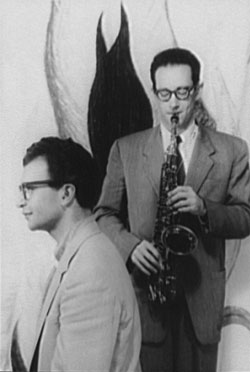
- Paul Desmond and Dave Brubeck picture. Retrieved from https://en.wikipedia.org/wiki/File:Desmond_brubeck_5a51762u.jpg

Leave a Reply