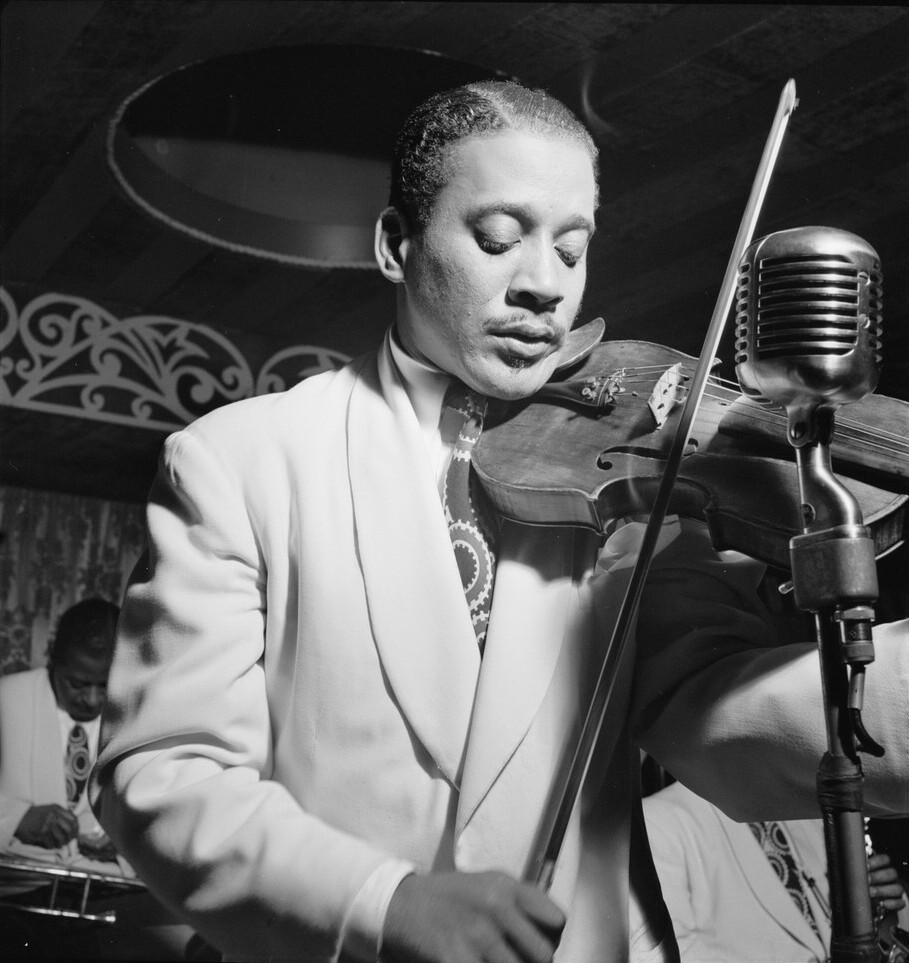
Introduction:
When discussing Duke Ellington’s orchestra, the conversation often turns to luminary soloists who defined the ensemble’s unique sound. Among them, Ray Nance stands out not just for his versatility as a trumpeter, violinist, and vocalist, but also for the charisma and flair he brought to Ellington’s band. Nance, a multi-instrumentalist and performer, carved out a legacy as one of jazz’s most distinctive artists.
Early Life and Introduction to Jazz:
Born one hundred and eleven years ago today on December 10, 1913, in Chicago, Ray Willis Nance began his musical journey in his youth, influenced by the vibrant jazz scene in the city. His journey into music started early, with childhood studies in piano and violin laying the groundwork for his future versatility. By high school, Nance had taught himself to play the trumpet, an instrument that would later define much of his career. His formative years included collaborations with swing legends Earl Hines and Horace Henderson, where he honed his skills not only as a trumpeter but also as a charismatic entertainer. These early experiences forged Nance into a multi-talented performer whose artistry would soon attract the attention of one of jazz’s most iconic bandleaders, Duke Ellington.
Help yourself to some live jazz, and help the artists and clubs fulfill their dreams. Sign up to Oh! Jazz to watch live and on-demand performances. 25% of your subscription goes back to the artists and 10% to the clubs.
Learn more about Oh! Jazz here.
Joining Duke Ellington’s Orchestra:
Ray Nance’s legacy with Duke Ellington’s orchestra is a pivotal chapter in jazz history, and his contributions remain iconic. In 1940, Ellington recruited Nance, appreciating his unique skills and showmanship, to replace the eminent trumpeter Cootie Williams. This decision marked the beginning of an illustrious period for Nance.
Nance’s first major performance with Ellington occurred at the now-famous Fargo, North Dakota ballroom dance, a session immortalized through live recordings. Shortly afterward, he was entrusted with the trumpet solo on the inaugural recording of “Take the ‘A’ Train,” a composition by Billy Strayhorn that would become Ellington’s signature tune. Nance’s solo on this track is celebrated for its heartfelt tone, inventive phrasing, and the way it encapsulated the energy and elegance of Ellington’s orchestra. This performance not only etched his name in jazz history but also cemented “Take the ‘A’ Train” as one of the genre’s definitive recordings.
Nance quickly became a key figure in Ellington’s band. Beyond his trumpet playing, he contributed to the ensemble’s texture with his violin—a rarity in jazz orchestras at the time. His violin solos, often infused with a bluesy charm, were highlights of Ellington’s concerts and recordings. His vocal abilities also shone, with Nance’s humorous, conversational singing style adding depth to the band’s performances.
The All-Purpose Performer:
What made Ray Nance unique was his multi-dimensional artistry. Known affectionately as “Floorshow” by his bandmates, he was as much a visual entertainer as a musical one. Whether he was dancing during performances or injecting wit into his solos, Nance brought a personal flair that delighted audiences.
His violin playing, while often overshadowed by his trumpet, was extraordinary. As one of the few jazz violinists of his era, Nance’s work on tracks like “The ‘C’ Jam Blues” demonstrated his innovative approach. He fused swing sensibilities with a touch of classical elegance, making his contributions to Ellington’s sound irreplaceable.
Life After Ellington:
Ray Nance remained with Ellington until 1963, marking over two decades of collaboration. After leaving the band, he continued performing as a freelance artist, leading his own small groups and appearing on recordings with artists like Johnny Hodges and Jaki Byard. Although his career slowed in later years, his influence on jazz remained profound.
Nance passed away in 1976, but his contributions to jazz endure. His ability to transition seamlessly between instruments, his humor, and his stage presence left an indelible mark on the genre.
Legacy and Influence:
Ray Nance’s legacy lies in his versatility and artistry. As a key member of Ellington’s orchestra, he not only upheld the ensemble’s tradition of excellence but also pushed its boundaries. His work with the violin paved the way for later jazz violinists, and his trumpet playing remains a benchmark for lyrical expression.
For listeners, Ray Nance serves as a reminder of the creative possibilities within jazz. His artistry reflects the genre’s spirit of innovation, where boundaries blur, and new forms emerge.
Further Listening:
To truly appreciate Ray Nance’s contributions, explore these essential recordings:
- “Take the ‘A’ Train” (1941): His trumpet solo on this Ellington classic is iconic.
- “The ‘C’ Jam Blues”: A showcase of Nance’s violin talents within Ellington’s band.
- “Jump for Joy”: Features his engaging vocal contributions.
References:
- Larkin, C. (1992). The Guinness Who’s Who of Jazz. Guinness Publishing.
- Lambert, E. (1998). Duke Ellington: A Listener’s Guide. Scarecrow Press.
- Ray Nance picture. Retrieved from https://en.wikipedia.org/wiki/File:Ray_Nance_(Gottlieb_06521).jpg
.jpg)
Leave a Reply