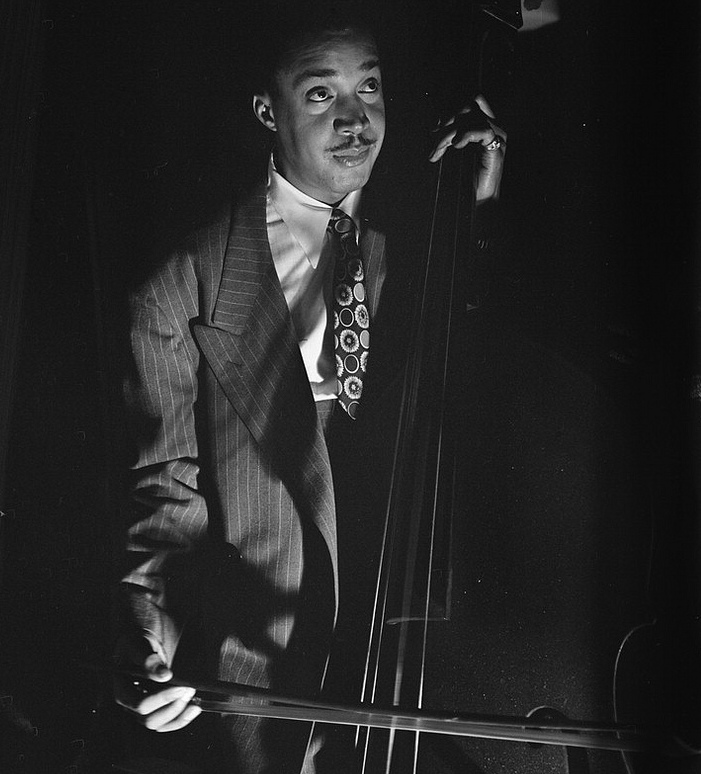
Introduction:
Slam Stewart, a towering figure in jazz bass playing, distinguished himself not only through his mastery of the instrument but also by developing a highly original and recognizable technique. Best known for his ability to bow his bass while humming an octave higher, Stewart’s unique sound and innovative approach made him one of the most beloved bassists of his time. His contributions to jazz spanned several decades, during which he worked with some of the greatest musicians in history. This post delves into his life, his remarkable contributions to jazz, and the legacy he left behind.
Early Life and Introduction to Music:
Born one hundred and ten years ago today on September 21, 1914, in Englewood, New Jersey, Leroy Eliot “Slam” Stewart came from a musical family. He started on the violin at a young age, but in high school, he transitioned to the string bass, an instrument that would define his career. His early music education took place at the Boston Conservatory, where he studied classical bass, and it was during these formative years that Stewart stumbled upon the signature style that would set him apart.
Help yourself to some live jazz, and help the artists and clubs fulfill their dreams. Sign up to Oh! Jazz to watch live and on-demand performances. 25% of your subscription goes back to the artists and 10% to the clubs.
Learn more about Oh! Jazz here.
Legend has it that Stewart’s unique approach of bowing while humming along with his playing was discovered by accident. The story goes that he was inspired by blues violinist Joe Turner, who sang along while playing his instrument. Stewart began to hum along as he bowed, a discovery that would become his trademark sound. This technique added an extra layer of texture to his performances and gave his playing a distinct vocal-like quality, almost mimicking the human voice in tandem with the bass’s deep resonance.
Slam Stewart and the Jazz Scene of the 1930s:
Stewart first entered the jazz scene in the 1930s, a golden era for swing music. He formed a duo with pianist and vocalist Slim Gaillard, known as Slim and Slam. Their partnership from 1936 to 1939 produced several popular hits, including the novelty tune “Flat Foot Floogie (with a Floy Floy),” which became a major success. The song’s playful and catchy melody was perfectly suited to Stewart’s quirky, yet virtuosic bass playing. The duo’s lighthearted approach to jazz made them favorites in clubs and on the radio.
While Stewart’s collaborations with Gaillard were rooted in humor and entertainment, they also showcased his extraordinary musicianship. His bowing technique, combined with his natural rhythmic feel, made him one of the standout bassists of the swing era. Stewart’s innate ability to maintain a driving beat while bowing gave him a versatility that few bassists of the time could match.
Post-Slim and Slam: Collaborations and Career Growth
After parting ways with Gaillard, Stewart’s career flourished as he transitioned from novelty acts to more serious jazz settings. In the 1940s, Stewart found himself in high demand, working with some of the leading names in jazz, including Art Tatum, Benny Goodman, and Dizzy Gillespie. His collaboration with Tatum, in particular, is still regarded as one of the most remarkable pairings in jazz history.
Another significant collaboration was Stewart’s work with bebop pioneer Dizzy Gillespie. In 1945, Stewart recorded with Gillespie’s band, which included Charlie Parker. This session, widely regarded as one of the pivotal moments in bebop, featured Stewart in a setting where the music’s complexity and intensity were a perfect match for his skill and creativity. His participation in such a forward-thinking project solidified his place not only as a swing bassist but as a musician capable of adapting to the rapidly changing jazz landscape.
The Bow and Hum Technique: Stewart’s Signature Sound
The most defining feature of Slam Stewart’s playing was, of course, his ability to bow while simultaneously humming an octave above the notes he played. While this technique may seem like a novelty on the surface, Stewart’s application of it in jazz was both innovative and expressive. It gave his bass playing a rich, melodic dimension, allowing him to function almost as a second horn player in ensemble settings. His dual-layered sound added depth to recordings and gave his performances a sense of playful elegance.
The bowing and humming technique was particularly effective in ballads and mid-tempo swing tunes. Stewart’s sound was not just a rhythmic foundation but a melodic voice within the ensemble, capable of interacting with soloists and providing counter-melodies. His use of vibrato and phrasing added a human-like quality to his bass lines, making him stand out from other bassists of the time, who primarily focused on plucking and walking basslines.
This technique has inspired many bassists over the years, including the renowned Ray Brown, who admired Stewart’s ability to blend melodic playing with a deep rhythmic groove.
Stewart’s Legacy:
Slam Stewart passed away on December 10, 1987, leaving behind a legacy that continues to inspire musicians to this day. His pioneering use of the bow and hum technique remains a hallmark of jazz bass playing, and his recordings with the likes of Art Tatum and Dizzy Gillespie are still regarded as essential listening for any serious jazz enthusiast.
Stewart’s contribution to jazz is often understated, but his influence on the evolution of the bass in jazz cannot be overlooked. He was one of the first bassists to elevate the instrument from a purely rhythmic role to a melodic and harmonic voice within the ensemble. His collaborations with some of the greatest names in jazz not only showcased his technical abilities but also his deep understanding of the music and his capacity for innovation.
Many modern jazz bassists owe a debt to Stewart’s trailblazing approach to the instrument. His ability to blend humor, melody, and rhythm into a cohesive and unique sound remains an inspiration to bass players across genres.
In conclusion, Slam Stewart was a bass virtuoso whose contributions to jazz were both profound and lasting. His distinctive bowing technique, coupled with his immense musicality, set him apart from his peers and solidified his place in the pantheon of great jazz bassists. As jazz continues to evolve, Stewart’s legacy as an innovator and master of his craft endures, reminding us of the transformative power of creativity in music.
References:
- Yanow, S. (2003). Jazz on Record – The First Sixty Years. Backbeat Books.
- Feather, L. & Gitler, I. (2007). The Biographical Encyclopedia of Jazz. Oxford University Press.
- Gioia, T. (2021). The History of Jazz. Oxford University Press.
- Slam Stewart picture. Retrieved from https://en.wikipedia.org/wiki/File:Slam_Stewart_(cropped).jpg
.jpg)
Leave a Reply