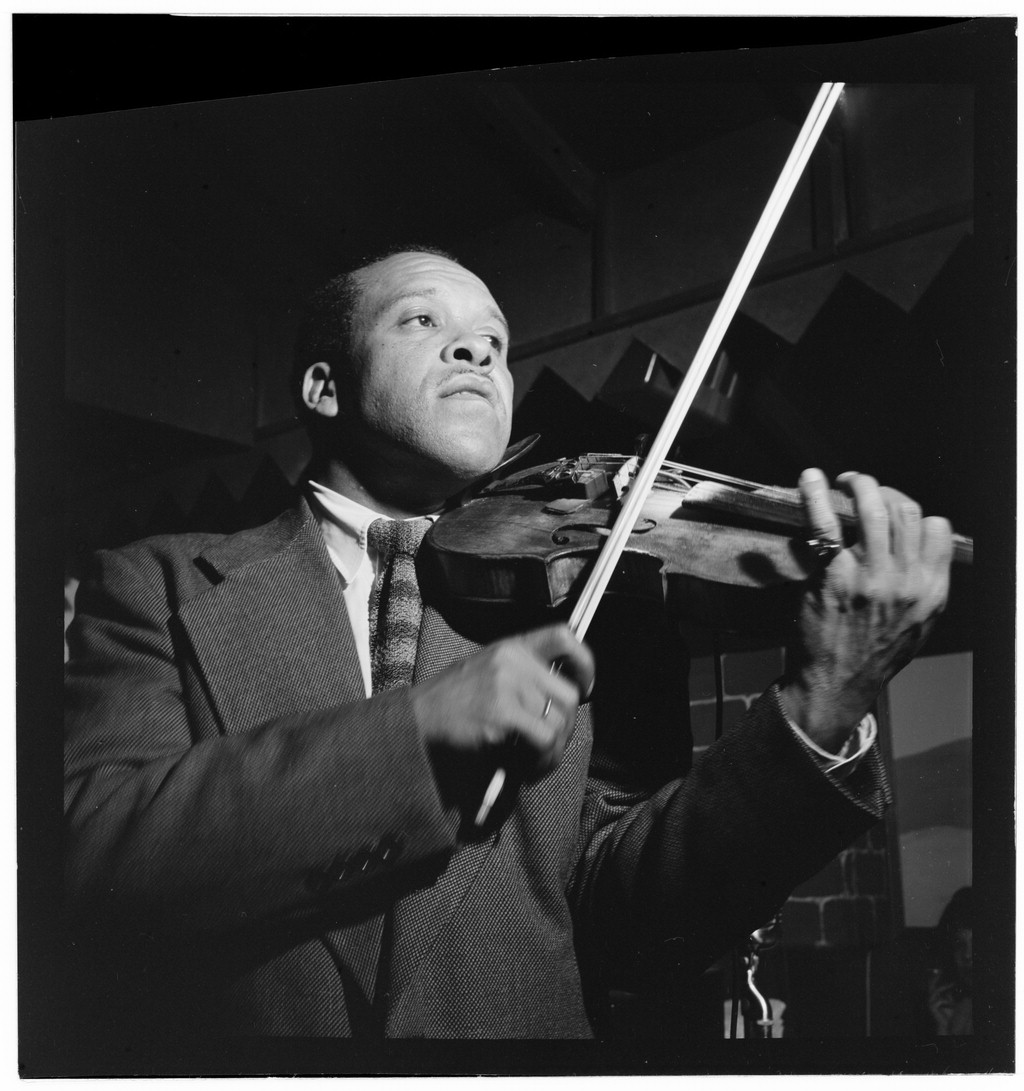
Introduction:
Jazz, with its rich and diverse history, has seen countless instrumentalists pushing the boundaries of their respective instruments, but few have done so with the sheer audacity and innovation of Stuff Smith. A pioneering jazz violinist, Smith broke away from traditional classical influences to carve out a unique place in jazz history. His contributions to the genre, particularly in swing and bebop, remain significant, even as other violinists like Stéphane Grappelli and Jean-Luc Ponty have often overshadowed him in popular memory. This post explores Smith’s extraordinary life, his innovative contributions to jazz, and his lasting legacy.
Early Life and Influences:
Hezekiah Leroy Gordon Smith, better known as Stuff Smith, was born one hundred and fifteen years ago today on August 14, 1909, in Portsmouth, Ohio. Music was a significant part of his life from an early age; his father, a preacher and a violinist himself, was Smith’s first teacher. However, it wasn’t the classical tradition that captured young Smith’s imagination. Instead, he was drawn to the rhythms of ragtime and the burgeoning jazz scene.
Help yourself to some live jazz, and help the artists and clubs fulfill their dreams. Sign up to Oh! Jazz to watch live and on-demand performances. 25% of your subscription goes back to the artists and 10% to the clubs.
Learn more about Oh! Jazz here.
Smith often cited Louis Armstrong as his primary influence, drawing inspiration from Armstrong’s dynamic style and charismatic stage presence. Like Armstrong, Smith was not just an instrumentalist but also a vocalist, seamlessly integrating his voice into his performances to create a multifaceted musical experience. In the 1920s, he honed his craft in Texas as a member of Alphonse Trent’s band, where he began to develop the innovative approach that would later define his career.
Breaking Boundaries: The Early Years
Smith’s early career was marked by a fierce determination to redefine the role of the violin in jazz. During the 1930s, he moved to New York City, where he became a regular performer at the Onyx Club, a hotspot for jazz musicians. It was here that he formed his most famous group, “Stuff Smith and His Onyx Club Boys.” The group’s style was exuberant and full of energy, a perfect match for the swing era’s high-octane atmosphere. Smith’s playing was characterized by a robust, swinging style that often mimicked the sound of a horn. This was a significant departure from the smoother, more classical-influenced styles of other jazz violinists like Joe Venuti. Smith was not interested in merely adapting classical techniques to jazz; he wanted to transform the violin into a frontline jazz instrument.
One of Smith’s most enduring contributions to jazz came in 1936 with the release of “I’se a Muggin’,” a playful tune that became a major hit and a signature song for Smith. The track featured not only Smith’s virtuoso violin playing but also his lively, humorous vocals, which added a new dimension to his performances. “I’se a Muggin’” captured the spirit of the era, combining swing’s rhythmic drive with a sense of fun and spontaneity that was quintessentially Stuff Smith.
The Innovator: Amplification and Electric Violin
Stuff Smith’s legacy as an innovator is perhaps most evident in his pioneering use of electric amplification for the violin. While electric guitars were becoming increasingly common in jazz, the idea of amplifying a violin was almost unheard of. Smith, however, recognized the potential of this technology to expand the violin’s sonic possibilities and make it more competitive with louder instruments in jazz ensembles.
In the late 1930s, Smith began experimenting with electric violins, working with manufacturers to develop models that suited his needs. His electrified sound was bold and assertive, allowing him to project over the brass and woodwinds in a way that had not been possible before. This was a game-changer for jazz violin, as it allowed the instrument to take on a more prominent, assertive role in ensembles.
Smith’s use of the electric violin not only influenced other violinists but also presaged the later developments in electric string instruments across various genres. His work laid the groundwork for future generations of jazz violinists who sought to push the instrument’s boundaries even further.
Collaborations and Bebop:
As the swing era gave way to bebop in the 1940s, Smith’s style evolved to keep pace with the changing jazz landscape. Bebop, with its fast tempos and complex harmonies, was a natural fit for Smith’s virtuosic technique and improvisational skills. He began collaborating with bebop pioneers like Dizzy Gillespie and Charlie Parker, adapting his playing to the new style while retaining the exuberance and creativity that had always defined his work.
Smith’s playing during this period was marked by even greater technical complexity and a willingness to explore dissonance and unconventional harmonies. His solos were often characterized by rapid-fire runs, intricate double stops, and an aggressive, percussive attack that set him apart from other bebop musicians. Yet, even amid these technical innovations, Smith never lost sight of the emotional core of his music. His playing remained deeply expressive, capable of conveying a wide range of emotions from joy to melancholy.
The Later Years and International Influence:
During the 1950s and 1960s, as jazz underwent significant changes and rock and roll began to dominate the American music scene, Stuff Smith found a new and appreciative audience in Europe. Relocating to Denmark in 1965, he quickly became a prominent figure in the European jazz community. Smith’s presence and performances had a profound impact, playing a crucial role in popularizing the jazz violin across the continent. His unique style and technical prowess resonated deeply with European audiences, solidifying his legacy as a pioneer who expanded the boundaries of jazz.
Legacy and Influence:
Stuff Smith passed away on September 25, 1967, but his influence on jazz and the violin continues to be felt to this day. His bold, innovative approach to the violin helped to redefine the instrument’s role in jazz, paving the way for future generations of violinists to explore new sounds and styles.
Smith’s legacy is particularly evident in the work of jazz violinists who followed in his footsteps, such as Jean-Luc Ponty, Leroy Jenkins, and Regina Carter. These artists, each in their own way, have built on the foundation that Smith laid, pushing the boundaries of what the violin can do in jazz and beyond.
Moreover, Smith’s pioneering use of the electric violin has had a lasting impact on the broader world of music. Today, electric violins are common in genres ranging from rock to electronic music, and many of the techniques and ideas that Smith pioneered are still in use.
Stuff Smith was more than just a jazz violinist; he was a visionary who transformed the way the violin was played and perceived in the world of jazz. His fearless innovation, combined with his deep musicality and technical prowess, made him a true original. Although his name may not be as widely recognized as some of his contemporaries, Smith’s contributions to jazz are undeniable, and his influence continues to resonate with musicians and listeners alike.
For those looking to explore Smith’s work, albums like “Have Violin, Will Swing” and “Black Violin” provide an excellent introduction to his unique style and virtuosity. As we listen to these recordings, we can appreciate the daring spirit and boundless creativity of an artist who was always ahead of his time.
References:
- Schuller, G. (1991). The Swing Era: The Development of Jazz, 1930-1945. Oxford University Press.
- Gioia, T. (2021). The History of Jazz. Oxford University Press.
- Shipton, A. (2008). A New History of Jazz. Continuum.
- DeVeaux, S. (1999). The Birth of Bebop: A Social and Musical History. University of California Press.
- Stuff Smith picture. Retrieved from https://en.wikipedia.org/wiki/File:Stuff_Smith.jpg

Leave a Reply