Introduction:
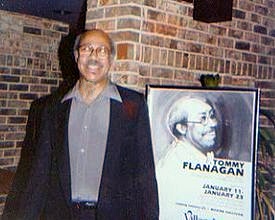
Tommy Flanagan was a jazz pianist renowned for his refined approach, harmonic sophistication, and lyrical touch. Despite not being as well-known as some of his contemporaries, Flanagan made significant contributions to jazz, inspiring innumerable players and leaving a rich legacy of recordings. In this blog article, we will look at Tommy Flanagan’s life, career, and music, focusing on his distinctive approach to the piano and long-lasting influence on jazz.
Early Life and Influences:
Tommy Flanagan was born ninety-four years ago today on March 16, 1930, in Detroit, Michigan. At the age of six, Flanagan received a clarinet as a Christmas gift from his parents. While he initially learned to read music through playing the clarinet, he soon developed a preference for the piano. Growing up, the Flanagan household had a piano, and Tommy received early lessons from his brother, Johnson, and later from Gladys Wade Dillard, who also taught Kirk Lightsey and Barry Harris. Flanagan attended Northern High School, where he was classmates with future saxophonist Sonny Red. His musical influences at the time included renowned pianists such as Art Tatum, Teddy Wilson, and Nat King Cole, whose records he avidly listened to, seeking to emulate their styles. Tommy displayed a natural talent for the piano from a young age, setting the stage for his remarkable musical career.
Help yourself to some live jazz, and help the artists and clubs fulfill their dreams. Sign up to Oh! Jazz to watch live and on-demand performances. 25% of your subscription goes back to the artists and 10% to the clubs.
Learn more about Oh! Jazz here.
Career Beginnings:
Flanagan’s debut concert occurred around 1945, where he performed alongside trombonist Frank Rosolino. During his teenage years, Flanagan played in a band led by Lucky Thompson, which also featured Pepper Adams and Kenny Burrell. Remarkably, while still a teenager, he had the opportunity to substitute for the pianist in Charlie Parker’s performances in Detroit. His move to New York City in 1956 marked a turning point in his career, as he swiftly gained recognition from luminaries like Miles Davis and Sonny Rollins. Impressed by his remarkable talent, both Davis and Rollins invited Flanagan to join their bands. His exceptional ability to both accompany and solo proficiently quickly established him as a highly sought-after pianist and a prominent figure in the jazz world.
Collaborations and Solo Career:
Flanagan worked with numerous jazz greats over his career, such as Ella Fitzgerald and John Coltrane. His skill, taste, and profound sense of harmony were all evident in his playing. With solo albums like “Jazz Poet” and “Thelonica,” Flanagan demonstrated his skill as a composer and jazz standard interpreter, garnering him praise from critics and a devoted fan base.
Later Years and Legacy:
In his later years, Flanagan continued to perform and record, maintaining his reputation as one of jazz’s premier pianists. He received numerous awards and accolades for his contributions to music, including five Grammy nominations. Flanagan’s legacy lives on through his recordings and the many pianists he influenced, who continue to study and perform his music.
Tommy Flanagan was a brilliant pianist whose graceful and lyrical playing made an unforgettable impression on jazz music. His contributions to the genre are praised by both musicians and listeners, and his recordings continue to influence future generations of jazz pianists. Flanagan’s ability to combine technical skill and emotional depth distinguished him as a unique musician, and his work is still ageless and relevant today.
References:
- Feather, L. & Gitler, I. (2007). The Biographical Encyclopedia of Jazz. Oxford University Press.
- Kernfeld, B. (2003). The New Grove Dictionary of Jazz. Oxford University Press.
- Giddins, G. (2000). Visions of Jazz: The First Century. Oxford University Press.
- Tommy Flanagan picture. Retrieved from https://en.wikipedia.org/wiki/File:Tommy_Flanagan.jpg

Leave a Reply